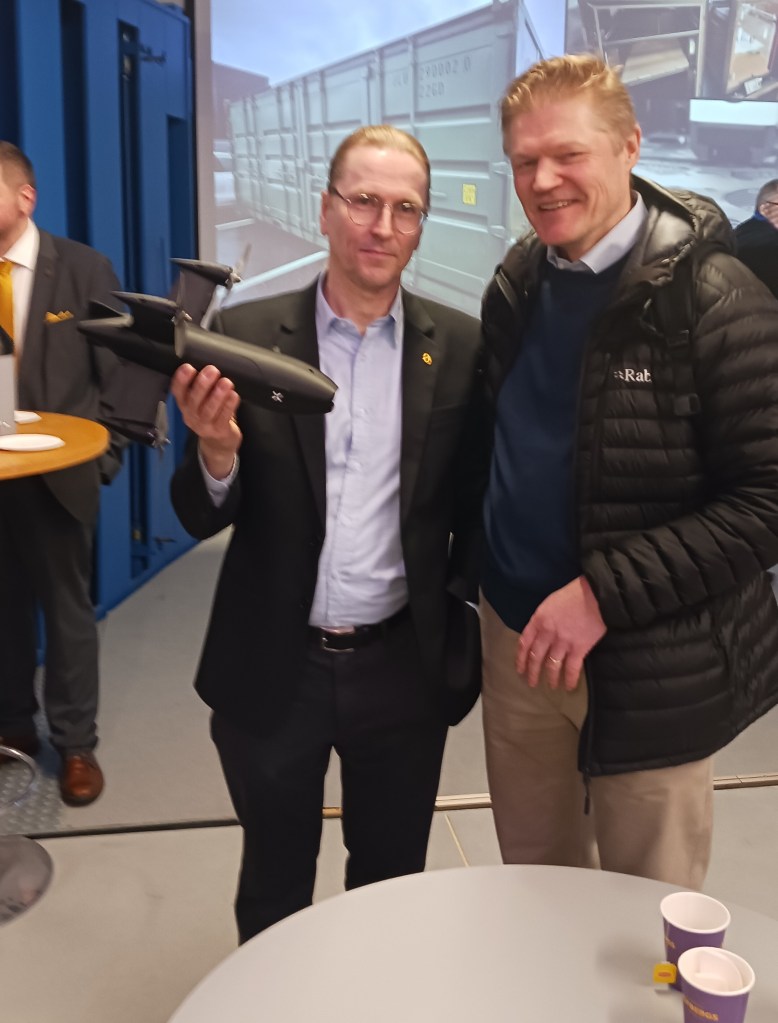
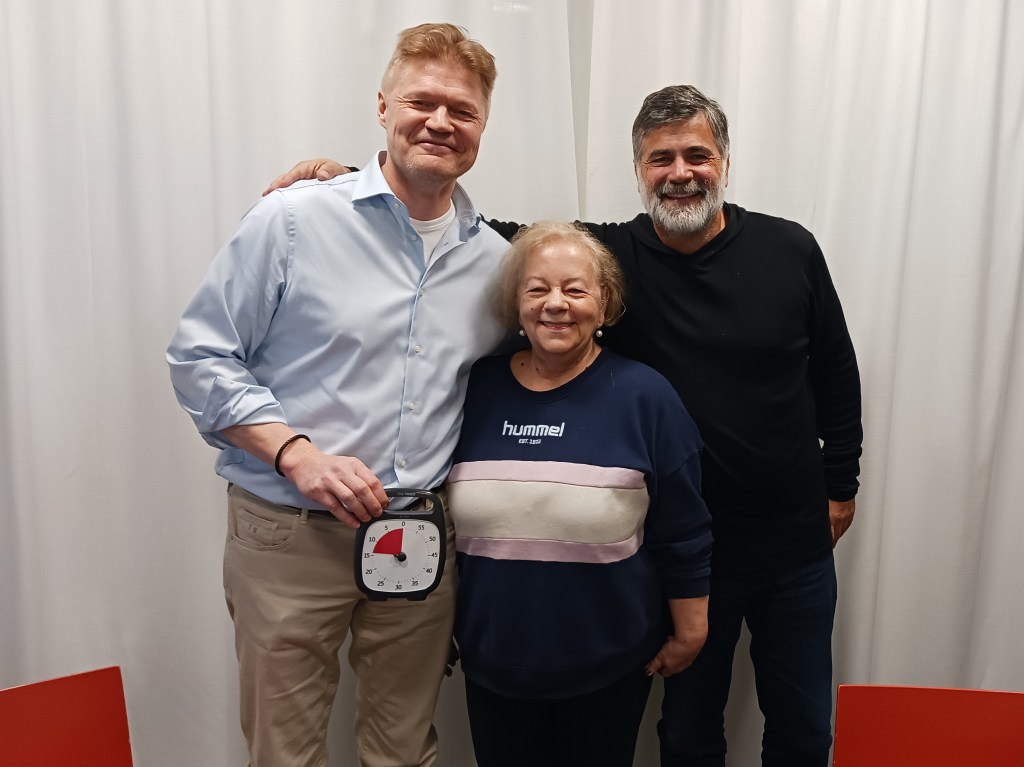
In Mikko’s hand, a drone that destroys drones. Behind us on the screen, a container that is actually a transportable drone factory that can make dozens of drones per day. 🚀🚀🚀🚀🚀🚀🚀
What’s the current state of drone warfare and drone defense in Ukraine 🇺🇦, Finland, and elsewhere? How does the future look like? 🚀
How does it sound when the topic is presented by one of the most knowledgeable experts in the field, Mikko Hyppönen, who is also perhaps the world’s #1 expert in drones in terms of presentation skills? 🎤
📌 Mikko’s content is always relevant, interesting and engaging for the audience.
📌 He always begins and ends on time.
📌 His visuals (PowerPoint) were full of insightful pictures and video.
📌 He had brought with him a bunch of props. In this case it was products of his own company Sensofusion, and a bunch of other drone-related artifacts.
Now I’ve held in my hand the kind of optical fibre the drones leave behind them and that now covers vast areas in Ukraine.
What you see in the photo is a drone that kills drones.
📌 Drones are scary, but as always, the more you know about a topic, it becomes slightly less scary. Drones are not omnipotent.
❓On another note, I asked Mikko how he prepares for his presentations nowadays, as compared to in the past, when he was still honing his presentation skills.
He’s a modest guy. His reply was that as he’s recently joined a new business, the main thing is to spend time learning lots and lots of new subject matter.
However, he added there’s one thing that hasn’t changed in his presentations:
He’s always considered himself to be an interpreter of making complex technical topics understandable and interesting to the general public.
This continues to be in the core of his presentations, wherever he speaks.
Have you ever listened to someone who’s able to distill a complex topic so that the audience gets it? 🔥
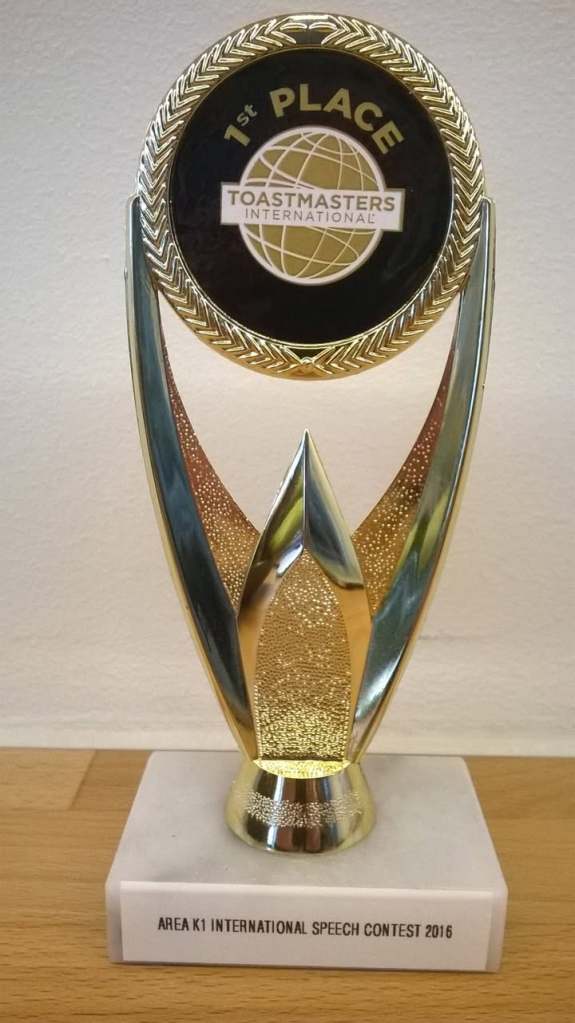
Many years ago I was a contestant at a public speaking contest. Tomorrow I’ll be hosting this same Toastmasters contest in Tallinn, with fantastic speakers from Estonia, Latvia, Lithuania and Finland 🔥🔥🔥
For the contest speech, you spend from 5 to 7 minutes on stage. As the master of ceremonies tomorrow, I’ll be on stage from 11:35am until 6pm. It already feels like running a marathon.
They say the shorter you need to make a speech, the more preparation it takes. The contestants have done a huge amount of preparation for their speeches and they deserve all the respect from the audience.
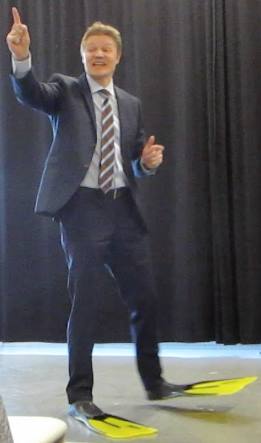
Wearing my “winning shoes” at a speech contest, telling a story about a duck and a couple of other animals.
Hosting an event is hard work, too, and requires careful planning and practice. Tomorrow there’s a minute-by-minute schedule of what will happen on stage between the opening words at 11:20am until the closing words at 6pm.
And something always goes wrong 😃 You need to be prepared for that, too.
The best thing is that you always learn something. And you improve your routine. And it’s fun.
Who’s the customer of a firm selling fish lures? It’s the fish 🐟
I learned this lesson about the business philosophy of the fish lure producer Rapala from the late professor of international business, Reijo Luostarinen, at the Helsinki School of Economics.
”You were amazing! This was the best townhall meeting ever!”
That’s what the audience of one of my clients told him after I had coached him on public speaking and presentations skills.
He had contacted me a couple of weeks earlier because he felt very nervous about an upcoming presentation.
It’s feedback like this that tells me I’ve been able to help someone at an important moment in their career.
This speaker is a C-level person at an international company that recently promoted him to lead a business unit of hundreds of people.
He wanted to be at his best when talking to a gathering of all his employees for the first time in his new role.
👉 Is your boss nervous about public speaking? I bet they are. Everyone is. Luckily we can all learn how to manage that nervousness.
I’m pretty sure all of Reijo Luostarinen’s students still remember the lesson about who your real customer is. How do I know? Because he told a story. Even better, it was a story with a hook 😀
What do you do when you realize you’re about to have a business meeting with a client, and at the reception desk you hear the person next to you is going to meet the same person at the same time? 😃
You network. 😃
I said ”Excuse me, I get the impression we’re about to meet the same person at the same time”.
We introduce ourselves to one another and assume there must be some kind of a misunderstanding.
While waiting for the meeting to begin, the Swedish guy and I have a conversation and realize we’re not competitors to each other. We exchange contact details and agree on a meeting about potentially working together at some point.
This happened yesterday.
I’ve seen a lot of interesting situations in meetings, but this was a first.
Sometimes buyers like to put people in awkward situations, but not that buyer I was about to meet, he is not that kind of a guy. Yesterday was about a misunderstanding.
What’s the strangest thing you’ve encountered in a meeting? 💥
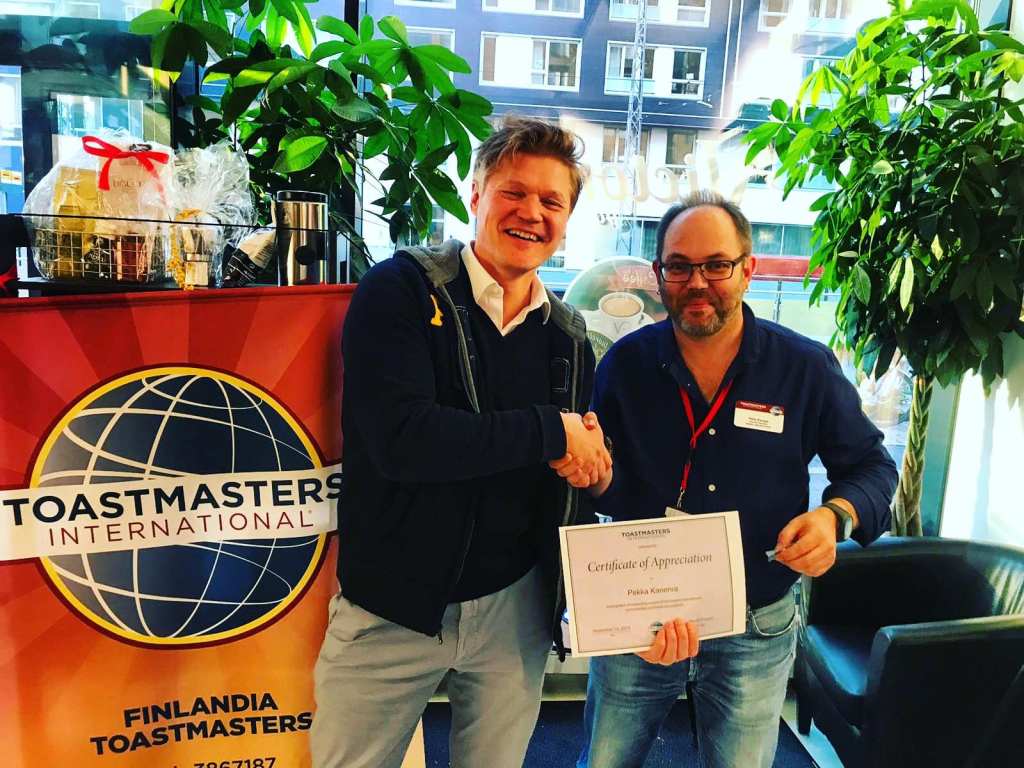
Photo: A blast from the past, when we used to meet at a local café in Helsinki, in 2019.
Join us tomorrow and practice your Spanish! 🇪🇸 🇨🇱🇵🇪🇨🇴🇻🇪
Finlandia Toastmasters meets again and as always, the program includes improvised speeches as well as prepared speeches that receive tailored evaluations by experienced speakers to maximize learning and personal development.
As to the atmosphere, we are a deadly serious club 😃
Join the meeting either online or face to face at Oodi Central Library in Helsinki, in meeting room #1, Wednesday Jan 21 at 6pm Finnish time.
The membership fee is a ridiculous 60 euros for half a year (plus a one-time fee of 20 euros for new members), and it’ll give you a tremendous boost on your Spanish and public speaking skills.
Having said that, you’re always welcome to visit for free to check us out.
You’ll meet people from various Spanish-speaking countries, as well as a couple of non-native speakers.
We meet twice a month, always on Wednesday’s at 6pm Finnish time.
January last year I flew over Greenland with a gorgeous sunset on the one side of the plane, and a full moon on the other.
In January 2025, flying over a gorgeous Greenland 🇬🇱 landscape, I had a conversation with a Danish woman about Greenland, war — and dog sleds 🐾. This chance encounter reminded me of the importance of listening more and talking less.
She knew someone who served in the Sirius Dog Sled Patrol (Slædepatruljen Sirius), the special military unit that tours remote parts of Greenland by dog sled.
The two of us had been randomly seated next to each other on a flight from Copenhagen to San Francisco, so we had time (11.5 hours to be exact). I enjoy listening to interesting strangers in airplanes.
She showed me a photo of a group of young men with long hair and a smile on their faces, somewhere in Greenland. These guys serve a two-year tour in Greenland, doing reconnaissance patrol on the uninhabited coastline. A single patrol trip may take months.
The dog sled isn’t about the Danish military being primitive. It’s that the conditions are primitive.
You can’t spend months in the icy wilderness relying on motor vehicles. There are no gas stations or motels.
Even though the patrols get supplies by air drops and from storage depots around Greenland, the dog sled is still superior on the ground compared to motor vehicles, as there are no roads in that part of the huge island.
In addition to the dog sleds patroling on the ground, the Danish military flies American F-35 fighter jets above Greenland. Also their navy is there.
We talked about all this because on January 7, 2025, Trump had publicly floated seizing Greenland.
Many people are asking why Trump is doing this. ”Why?” is a common question when talking about war.
One of my strongest memories from the Oscar-winning documentary 20 Days in Mariupol is about bewildered local people asking exactly that: “Why? Why are they bombing our homes? We have done nothing, we want to live in peace.”
The sad thing is that for some things in life no sensible answers seem to exist. I believe there is no reason here that makes sense, except the flawed character of an authoritarian ruler.
You listen to such rulers talk, and sometimes listening simply reveals that there’s no coherent moral logic there. That, too, is useful information.
Europe has seen already before the damage authoritarian rulers may inflict. Practically speaking, World War Two in Europe began with Stalin’s and Hitler’s alliance. For both of them, a million people killed was just a statistic, as the saying goes.
Today, Europe lies again between two authoritarian rulers, and we need to be ready for whatever may come.
We need to take action, but we also need something else.
As a public speaking coach, people assume I’m mostly interested in speaking. I am — but I’m even more interested in listening.
I learn more by listening to the stories of others than those of my own. In the bigger picture, if we want to get along in this world, we don’t need more talk, we need more listening.
Because with enough patience, we sometimes find moments that open a door, a chance to build common ground. Not with everyone. But with some people. And that could be a beginning of something positive.
On this flight from Copenhagen to San Francisco, I learned about the famous dog sled patrol in Greenland.
👉 When was the last time a stranger taught you something useful you didn’t expect?
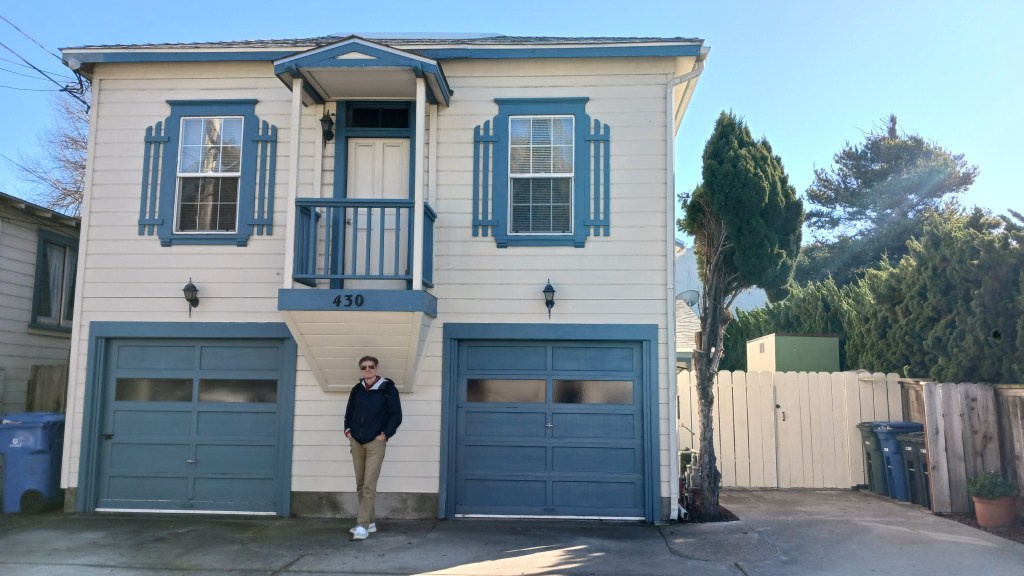
Me in front of my old house in Monterey. When I came back on January 14, 2025, it looked just the same as in January 1993 — even the paint colors were the same.
This photo could have been taken yesterday — or 33 years ago ⏳. That’s when this house in Monterey, California, became my home for six months, a period that in many ways made me who I am today.
Already at that time, California was an inspiration to the world in many ways, so I felt I was at the right place at the right time.
Looking back, three things stand out from my six months in Monterey:
🌱 I became confident I could build a life in another country. Until then, I wasn’t sure I could thrive outside my home country.
🌱 My interaction skills improved, and it was not just about learning to speak English with more ease than before. For example, many people in my native Finland are not used to giving casual compliments to others. Hence, learning to say a simple ”thank you” after receiving a compliment was a revelation to me.
In Europe, Americans are sometimes perceived as superficial, but my experience is they simply tend to have the skill to interact with people in a friendly way, often more so than in many other countries.
🌱 I met someone who helped me grow as a person. We didn’t last, but my belief that I could one day find the right match did.
We are defined by the choices we make that others don’t. Every ”road less traveled” becomes a chapter in our life’s story.
For example:
📍 My high school didn’t require me to study Spanish and to spend a year in Caracas, Venezuela, as an exchange student, but I did.
📍 My exchange student organization didn’t require me to visit the Soviet Union for two weeks in 1988, but I jumped at the opportunity to travel to Mariupol in what was then Soviet Ukraine. I stayed with a host family and got to know the locals.
📍 My business school curriculum didn’t require me to study a semester abroad in 1993, but I decided to go.
📍 January last year, I took another trip to California to get together with family I hadn’t seen in quite a while. Another important motive was to be there to witness a historical breaking point for the US and for the world. I wanted to be there during the last days of the America I had come to know and to feel the looming change. I knew I would regret it if I didn’t make that trip.
In 1993 my room was behind the upper right-hand window in the photo. In the mornings, I woke up to the sea lions at the nearby Monterey harbor. Writing this now, I can still hear them.
I believe that, in addition to the place where we grew up, we all have at least one place in the world that forms a part of our heart and soul. ❤️
What’s the one choice — and the one place — that has shaped you more than you expected? 💡
What keeps you motivated?🔥🔥🔥 What keeps me going is feedback like this message I received from someone I was able to help recently:
”Happy New Year to my mentor in the toughest of times.
There are moments when I wonder why I don’t simply walk off stage and exit quietly. But then I think of people like you. Full of wisdom, clarity, and kindness, and whose presence has made the whole journey meaningful.
Your feedback, your perspective, and the way you helped me grow mattered more than you probably realise.”
📌 Giving honest and positive feedback doesn’t cost you anything but it will make at least two people happy. A piece of feedback can mean the world to people. It will certainly boost their morale and their motivation to keep going and work harder to achieve something even better.
👉 When you catch someone doing something good, tell them.
Paneelikeskustelun pitämistä harjoittelemassa Izabel Velez, Roberto Bolomey ja allekirjoittanut.
Mitä hyötyä saan Toastmasters-puheklubista yli kymmenen vuoden jäsenyyden jälkeen? Tässä on muutama esimerkki.
Toastmasters-kokouksissa pidetään puheita, mikä auttaa minua pitämään yllä lavarutiinia.
Kun on jatkuvasti yleisön edessä, ”tosielämän” esiintymiskeikat eivät näyttäydy poikkeuksellisina haasteina.
Kokouksissa ei harjoitella vain puheenpitoa, vaan kaikkia kuviteltavissa olevia esiintymistilanteita.
Esimerkiksi yksi osa valmistautumistani maanantaina olleeseen keikkaan, jossa juonsin vaativan paneelikeskustelun, oli tietysti paneelikeskustelun vetäminen Toastmasters-kokouksessa.
Perusasioita on aina hyvä kerrata. Toistoja, toistoja, toistoja.
Kuvassa aina luotettavat panelistit Izabel Velez ja Roberto Bolomey. Kuvan otti yksityiskohtaisen palautteen antanut Oscar Santolalla. Vaikeusasteen lisäämiseksi tämä harjoitus tehtiin espanjan kielellä.
Toastmasters-kokouksissa voi kokeilla uusia ideoita ja testata miten ne toimivat käytännössä.
Uuden puhekikan tai harjoituksen ensimmäistä kokeilua ei kannata tehdä työpaikalla tai asiakkaan edessä.
Ensimmäisestä vedosta löytyy aina jotain parannettavaa tositilanteeseen. Joskus käy myös niin, että huomaa paperilla hyvältä kuulostavan idean toimimattomaksi käytännön puhe- tai opetustilanteessa.
Toastmasters on loistava harjoitteluympäristö, jossa mokaaminenkin on hauskaa.
Panelisteina olivat Nina Järvenkylä, Jussi Konttinen ja Pauliina Siniauer. Kaikki ovat olleet Ukrainassa raportoimassa siellä käynnissä olevasta sodasta.
Juonsin toissa iltana paneelikeskustelun väestönsuojelusta Ukrainan sodassa. Panelisteina oli Ukrainassa Suomen johtaville medioille työskennelleitä toimittajia.
Paneelikeskustelun aikana koin tilanteen, joka keskustelun moderaattorille, aivan kuten puheenpitäjälle, voi joskus sattua: huomasin yleisön olevan aivan hiljaa ja lähes eleetöntä.
Tämä on jännittävä paikka, koska se voi tarkoittaa kahta päinvastaista asiaa: joko yleisöllä on tylsää tai se kuuntelee intensiivisesti.
Koska en nähnyt kenenkään räpläävän puhelinta vaan ennemminkin useiden kirjoittavan kiivaasti muistiinpanoja ja loppujen katsovan puhujien suuntaan, päättelin kaiken olevan hyvin.
Nyt, kaksi päivää paneelin jälkeen, me tilaisuuden järjestäjät olemme yhä kokoamassa osallistujien muistiinpanoja ja tekemässä niistä yhteenvetoa. Niin paljon keskustelu antoi ajateltavaa.
Siksi pohdin, miten tämä kaikki tapahtui, ja mieleen tuli kolme ajatusta paneelikeskustelun juontamisesta. Näistä lienee hyötyä, jos haluaa keskustelusta maksimaalisen hyödyn yleisölle.
1. Fokus. Paneelin vetäjän on osattava keskittyä moneen asiaan yhtä aikaa
“Juontajan tulee jatkuvasti katsoa omien papereidensa lisäksi sekä jokaista panelistia että yleisöä. Lisäksi hänellä täytyy samaan aikaan olla mielessä tapahtuman ohjelma, aikataulutus ja omat vuorosanat. Samalla pitää tehdä muistiinpanoja.”
Paneelikeskustelun juontaminen on intensiivistä työtä, vaikka se ei näytä siltä.
Jos pidät puheen, joudut keskittymään samanaikaisesti ”vain” kahteen asiaan: omaan ilmaisuusi ja yleisöön.
Paneelikeskustelun juontaja taas joutuu näiden lisäksi samanaikaisesti keskittymään myös panelisteihin sekä heidän sanalliseen ja sanattomaan ilmaisuunsa.
Juontajan tulee jatkuvasti katsoa omien papereidensa lisäksi sekä jokaista panelistia että yleisöä. Lisäksi hänellä täytyy samaan aikaan olla mielessä tapahtuman ohjelma, aikataulutus ja omat vuorosanat. Samalla pitää tehdä muistiinpanoja.
Tämä kaikki vaatii äärimmäistä keskittymistä.
Jos pakka ei ole kasassa, juontaja ei pysty lennosta kysymään relevantteja jatkokysymyksiä, ohjaamaan yleisökysymyksiä oikealle henkilölle tai tekemään keskustelun lopuksi yhteenvetoa puhutusta.
2. Perehtyminen. Paneelin vetäjän täytyy tuntea aihe ja yleisö perin pohjin
Juontaja ei voi keskittyä useaan asiaan yhtä aikaa, jos hän ei tunne hyvin sekä keskusteltavaa aihetta, keskustelijoita että tilaisuuden yleisöä.
Juontajan pitää ennen tilaisuuden alkua olla perillä siitä, mitä keskustelijat todennäköisesti sanovat ja mitä yleisö todennäköisesti kysyy.
Siksi olin palaveerannut panelistien kanssa etukäteen ja lukenut heidän kirjoittamiaan tekstejä. Siksi olin myös keskustellut järjestäjätiimin kanssa etukäteen. Lisäksi katsoin yhden dokumenttielokuvan, luin aihepiirin uutisia ja selasin muutaman kirjan.
Koska kuulun yleisönä olleeseen yhteisöön, tiesin, mitkä illan teemaan liittyvät asiat yleisöä askarruttavat. Tiesin myös, mikä on heille jo ennestään itsestään selvää.
Koska teemana oli sodanaikainen väestönsuojelu Ukrainassa, oli hyötyä siitä, että olen perehtynyt väestönsuojeluun, suorittanut varusmiespalveluksen ja matkustanut Ukrainassa. Lisäksi tunnen sotahistoriaa ja Ukrainassa sotaa käyvien maiden historiaa ja yhteiskuntaa. Yleinen elämänkokemuskin auttaa.
Lisäksi juontajaa auttaa esiintymiskokemus ja paneelikeskustelujen juontamisen rutiini. Ei tarvitse kaiken muun lisäksi miettiä, miten hallitsee esiintymisjännitystä.
3. Työmäärä. Onnistuneen paneelin järjestäminen vaatii hämmästyttävän määrän työtä
Yllä olevasta on helppo päätellä, että vaikka illan aihe olikin minulle ennestään kohtalaisen tuttu, tilaisuuden järjestäminen vaatii paljon työaikaa sekä ennen tilaisuutta, sen aikana että sen jälkeen.
Puolentoista tunnin tilaisuus on puolentoista tunnin tilaisuus ainoastaan tilaisuuden yleisölle.
Ennen tilaisuuden alkusanojen lausumista järjestävä tiimi on tehnyt paljon suunnittelua ja koordinointia, lähettänyt paljon viestejä ja pitänyt muutaman palaverin järjestäjien ja panelistien kesken. Monenlaiseen taustamateriaaliin on perehdytty. On kirjoitettu ja ajastettu tapahtuman ohjelma sekä juontajan vuorosanat.
Sen jälkeen on harjoiteltu. On tiedotettu ja käyty vuoropuhelua sekä panelistien että yleisön kanssa.
Tilaisuuden jälkeen kiitettiin osallistujia ja kerättiin palautteet. Järjestäjät pitivät tuoreeltaan debriefingin ja kävivät läpi, mitä opittiin. Lisäksi tehdään vielä yhteenveto tapahtuman asiasisällöstä, jotta keskustelun opit eivät jää unohduksiin. Sitten ideoidaan, mitä tehdään seuraavaksi.
Noin se menee, kun asiat hoitaa kunnolla.
Keskinkertaista saa helposti. Jos haluaa laatua, siihen pitää panostaa.
Jo samana iltana saimme muun muassa seuraavanlaista spontaania kirjallista palautetta:
”Kiitokset järjestäjille – erinomainen sessio!”, ”Huikean hyvä” ja ”Aika lensi kyl”.
Asiantuntijasta juontajaksi vai päinvastoin?
Lopuksi jäin pohtimaan, onko helpompaa tehdä asiantuntijasta erinomainen paneelikeskustelun juontaja vai ammattijuontajasta paneelin aiheen asiantuntija.
Paras vaihtoehto on tietysti, että ammattijuontaja on jo valmiiksi paneelin teeman asiantuntija. Tämä ei kuitenkaan aina ole mahdollista.
Ihanteellisesti jokainen asiantuntija oppisi koulussa hyväksi esiintyjäksi, mutta todellisuudessa näin ei tapahdu. Puhujaksi ja moderaattoriksi oppiminen vaatii yksilöltä vahvaa omaa motivaatiota ja pitkäaikaista panostusta.
Siksi asiantuntija, joka on osaava esiintyjä ja paneelin juontaja on työnantajalleen kullan arvoinen.
Entä toisinpäin? Keskittyykö ammattijuontaja paneelikeskustelussa naurattamaan yleisöä siksi, että keskustelun substanssi ei ole hallussa? Veikkaan, että tällaistakin tapahtuu. Yleisön viihdyttäminen on hyvä asia, mutta se ei yksin riitä.
Jos ammattijuontaja on käynyt kouluja, hän on oppinut oppimaan. Hän kykenee perehtymään itselleen vieraaseenkin aiheeseen. Tekoäly toki antaa nopeasti pinnallista asiantuntijuutta, mutta kantaa vain osan matkaa.
Vähänkin syvällisempi perehtyminen ja olennaisen omaksuminen vaatii aikaa. Tämä kannattaa tapahtuman järjestäjän muistaa, kun rekrytoi tilaisuuteensa ammattijuontajaa.


 Would you like to become a better communicator?