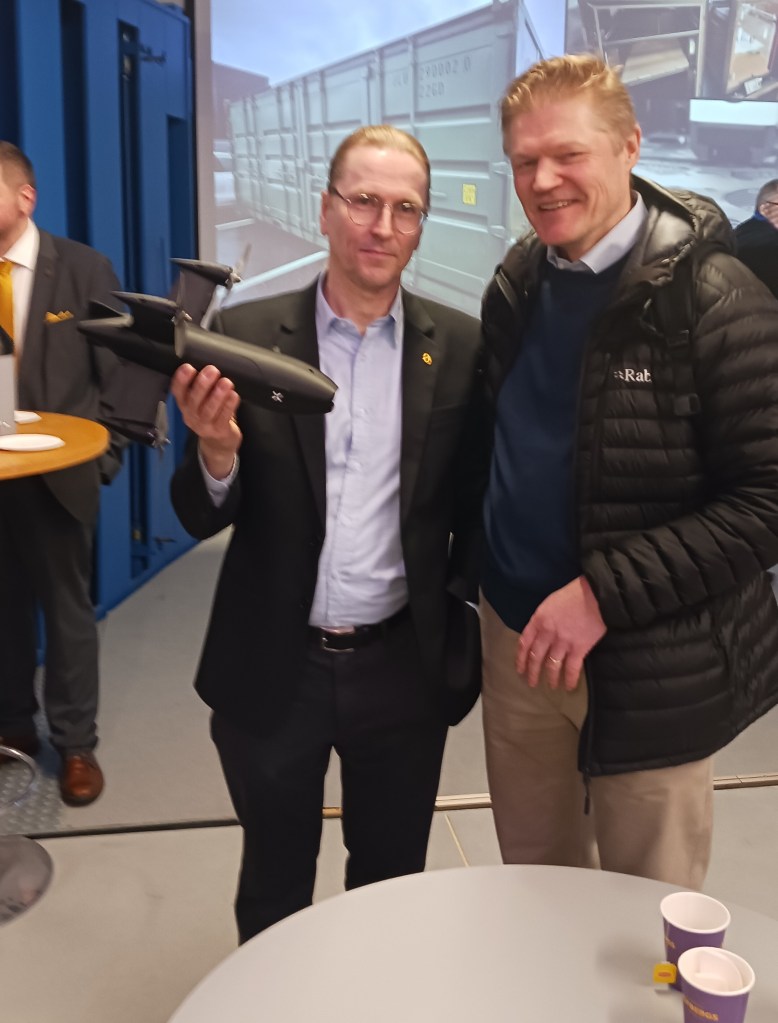
In Mikko’s hand, a drone that destroys drones. Behind us on the screen, a container that is actually a transportable drone factory that can make dozens of drones per day. 🚀🚀🚀🚀🚀🚀🚀
What’s the current state of drone warfare and drone defense in Ukraine 🇺🇦, Finland, and elsewhere? How does the future look like? 🚀
How does it sound when the topic is presented by one of the most knowledgeable experts in the field, Mikko Hyppönen, who is also perhaps the world’s #1 expert in drones in terms of presentation skills? 🎤
📌 Mikko’s content is always relevant, interesting and engaging for the audience.
📌 He always begins and ends on time.
📌 His visuals (PowerPoint) were full of insightful pictures and video.
📌 He had brought with him a bunch of props. In this case it was products of his own company Sensofusion, and a bunch of other drone-related artifacts.
Now I’ve held in my hand the kind of optical fibre the drones leave behind them and that now covers vast areas in Ukraine.
What you see in the photo is a drone that kills drones.
📌 Drones are scary, but as always, the more you know about a topic, it becomes slightly less scary. Drones are not omnipotent.
❓On another note, I asked Mikko how he prepares for his presentations nowadays, as compared to in the past, when he was still honing his presentation skills.
He’s a modest guy. His reply was that as he’s recently joined a new business, the main thing is to spend time learning lots and lots of new subject matter.
However, he added there’s one thing that hasn’t changed in his presentations:
He’s always considered himself to be an interpreter of making complex technical topics understandable and interesting to the general public.
This continues to be in the core of his presentations, wherever he speaks.
Have you ever listened to someone who’s able to distill a complex topic so that the audience gets it? 🔥
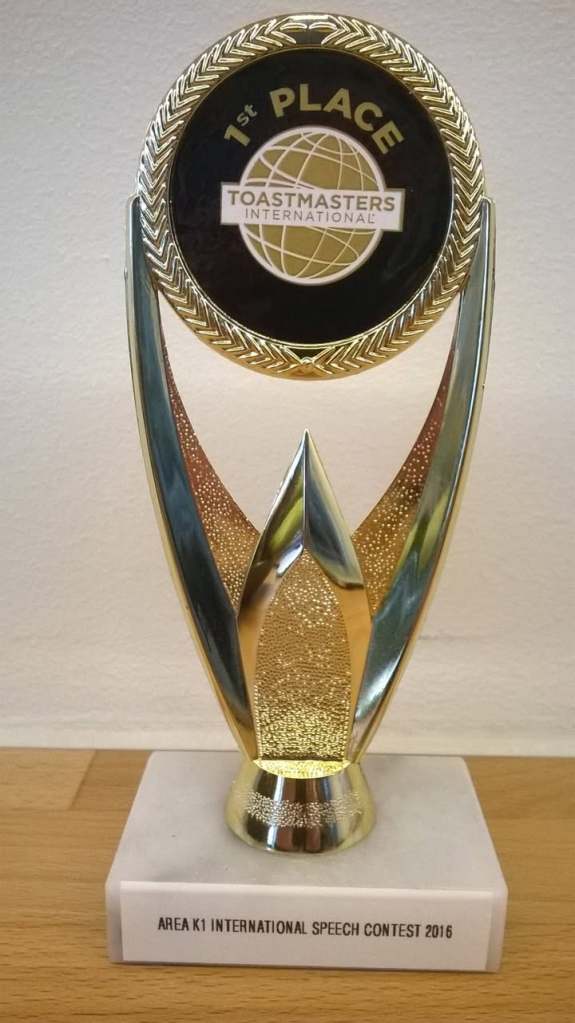
Many years ago I was a contestant at a public speaking contest. Tomorrow I’ll be hosting this same Toastmasters contest in Tallinn, with fantastic speakers from Estonia, Latvia, Lithuania and Finland 🔥🔥🔥
For the contest speech, you spend from 5 to 7 minutes on stage. As the master of ceremonies tomorrow, I’ll be on stage from 11:35am until 6pm. It already feels like running a marathon.
They say the shorter you need to make a speech, the more preparation it takes. The contestants have done a huge amount of preparation for their speeches and they deserve all the respect from the audience.
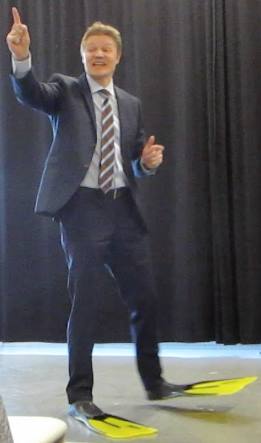
Wearing my “winning shoes” at a speech contest, telling a story about a duck and a couple of other animals.
Hosting an event is hard work, too, and requires careful planning and practice. Tomorrow there’s a minute-by-minute schedule of what will happen on stage between the opening words at 11:20am until the closing words at 6pm.
And something always goes wrong 😃 You need to be prepared for that, too.
The best thing is that you always learn something. And you improve your routine. And it’s fun.
Who’s the customer of a firm selling fish lures? It’s the fish 🐟
I learned this lesson about the business philosophy of the fish lure producer Rapala from the late professor of international business, Reijo Luostarinen, at the Helsinki School of Economics.
”You were amazing! This was the best townhall meeting ever!”
That’s what the audience of one of my clients told him after I had coached him on public speaking and presentations skills.
He had contacted me a couple of weeks earlier because he felt very nervous about an upcoming presentation.
It’s feedback like this that tells me I’ve been able to help someone at an important moment in their career.
This speaker is a C-level person at an international company that recently promoted him to lead a business unit of hundreds of people.
He wanted to be at his best when talking to a gathering of all his employees for the first time in his new role.
👉 Is your boss nervous about public speaking? I bet they are. Everyone is. Luckily we can all learn how to manage that nervousness.
I’m pretty sure all of Reijo Luostarinen’s students still remember the lesson about who your real customer is. How do I know? Because he told a story. Even better, it was a story with a hook 😀
What do you do when you realize you’re about to have a business meeting with a client, and at the reception desk you hear the person next to you is going to meet the same person at the same time? 😃
You network. 😃
I said ”Excuse me, I get the impression we’re about to meet the same person at the same time”.
We introduce ourselves to one another and assume there must be some kind of a misunderstanding.
While waiting for the meeting to begin, the Swedish guy and I have a conversation and realize we’re not competitors to each other. We exchange contact details and agree on a meeting about potentially working together at some point.
This happened yesterday.
I’ve seen a lot of interesting situations in meetings, but this was a first.
Sometimes buyers like to put people in awkward situations, but not that buyer I was about to meet, he is not that kind of a guy. Yesterday was about a misunderstanding.
What’s the strangest thing you’ve encountered in a meeting? 💥
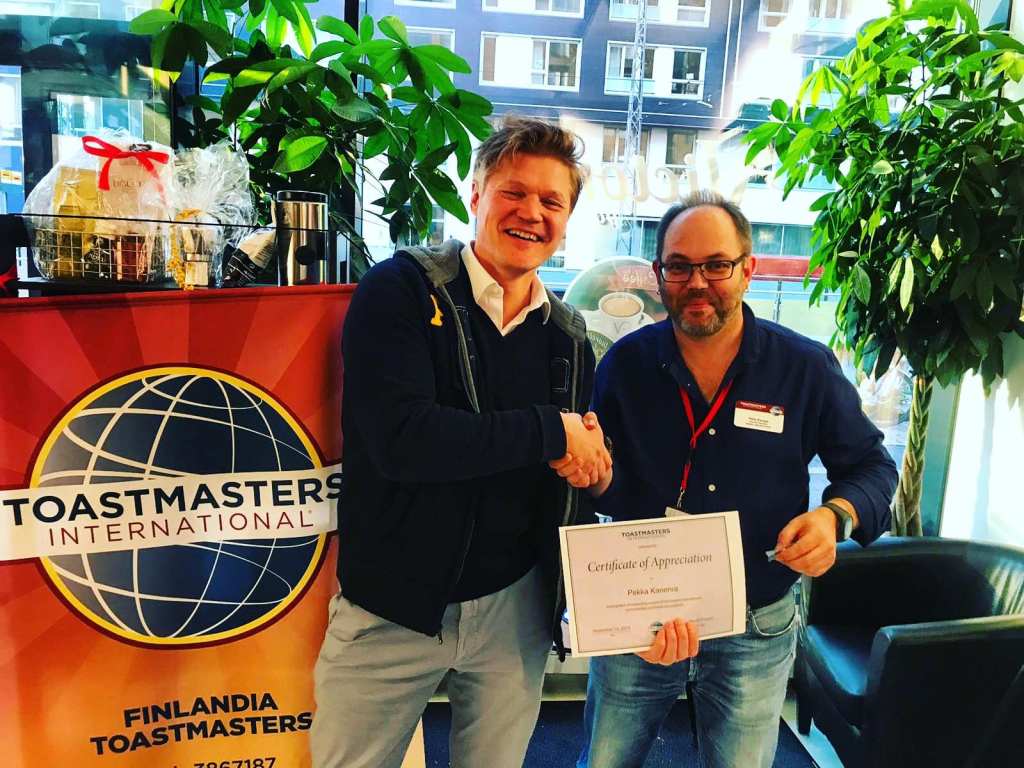
Photo: A blast from the past, when we used to meet at a local café in Helsinki, in 2019.
Join us tomorrow and practice your Spanish! 🇪🇸 🇨🇱🇵🇪🇨🇴🇻🇪
Finlandia Toastmasters meets again and as always, the program includes improvised speeches as well as prepared speeches that receive tailored evaluations by experienced speakers to maximize learning and personal development.
As to the atmosphere, we are a deadly serious club 😃
Join the meeting either online or face to face at Oodi Central Library in Helsinki, in meeting room #1, Wednesday Jan 21 at 6pm Finnish time.
The membership fee is a ridiculous 60 euros for half a year (plus a one-time fee of 20 euros for new members), and it’ll give you a tremendous boost on your Spanish and public speaking skills.
Having said that, you’re always welcome to visit for free to check us out.
You’ll meet people from various Spanish-speaking countries, as well as a couple of non-native speakers.
We meet twice a month, always on Wednesday’s at 6pm Finnish time.
January last year I flew over Greenland with a gorgeous sunset on the one side of the plane, and a full moon on the other.
In January 2025, flying over a gorgeous Greenland 🇬🇱 landscape, I had a conversation with a Danish woman about Greenland, war — and dog sleds 🐾. This chance encounter reminded me of the importance of listening more and talking less.
She knew someone who served in the Sirius Dog Sled Patrol (Slædepatruljen Sirius), the special military unit that tours remote parts of Greenland by dog sled.
The two of us had been randomly seated next to each other on a flight from Copenhagen to San Francisco, so we had time (11.5 hours to be exact). I enjoy listening to interesting strangers in airplanes.
She showed me a photo of a group of young men with long hair and a smile on their faces, somewhere in Greenland. These guys serve a two-year tour in Greenland, doing reconnaissance patrol on the uninhabited coastline. A single patrol trip may take months.
The dog sled isn’t about the Danish military being primitive. It’s that the conditions are primitive.
You can’t spend months in the icy wilderness relying on motor vehicles. There are no gas stations or motels.
Even though the patrols get supplies by air drops and from storage depots around Greenland, the dog sled is still superior on the ground compared to motor vehicles, as there are no roads in that part of the huge island.
In addition to the dog sleds patroling on the ground, the Danish military flies American F-35 fighter jets above Greenland. Also their navy is there.
We talked about all this because on January 7, 2025, Trump had publicly floated seizing Greenland.
Many people are asking why Trump is doing this. ”Why?” is a common question when talking about war.
One of my strongest memories from the Oscar-winning documentary 20 Days in Mariupol is about bewildered local people asking exactly that: “Why? Why are they bombing our homes? We have done nothing, we want to live in peace.”
The sad thing is that for some things in life no sensible answers seem to exist. I believe there is no reason here that makes sense, except the flawed character of an authoritarian ruler.
You listen to such rulers talk, and sometimes listening simply reveals that there’s no coherent moral logic there. That, too, is useful information.
Europe has seen already before the damage authoritarian rulers may inflict. Practically speaking, World War Two in Europe began with Stalin’s and Hitler’s alliance. For both of them, a million people killed was just a statistic, as the saying goes.
Today, Europe lies again between two authoritarian rulers, and we need to be ready for whatever may come.
We need to take action, but we also need something else.
As a public speaking coach, people assume I’m mostly interested in speaking. I am — but I’m even more interested in listening.
I learn more by listening to the stories of others than those of my own. In the bigger picture, if we want to get along in this world, we don’t need more talk, we need more listening.
Because with enough patience, we sometimes find moments that open a door, a chance to build common ground. Not with everyone. But with some people. And that could be a beginning of something positive.
On this flight from Copenhagen to San Francisco, I learned about the famous dog sled patrol in Greenland.
👉 When was the last time a stranger taught you something useful you didn’t expect?
What keeps you motivated?🔥🔥🔥 What keeps me going is feedback like this message I received from someone I was able to help recently:
”Happy New Year to my mentor in the toughest of times.
There are moments when I wonder why I don’t simply walk off stage and exit quietly. But then I think of people like you. Full of wisdom, clarity, and kindness, and whose presence has made the whole journey meaningful.
Your feedback, your perspective, and the way you helped me grow mattered more than you probably realise.”
📌 Giving honest and positive feedback doesn’t cost you anything but it will make at least two people happy. A piece of feedback can mean the world to people. It will certainly boost their morale and their motivation to keep going and work harder to achieve something even better.
👉 When you catch someone doing something good, tell them.
Just for the heck of it, a keynote speech in ten seconds 😀
It’s this time of the year again: the season of the Toastmasters autumn speech contests. All over the world, people are competing in two categories: humorous speeches and improvised speeches. Loads of fun.
This Saturday, I’ll be hosting this speech contest in Helsinki. It’s called an area contest, with participants from Finland and Estonia.
No one, except me, knows the topic of the improvised speeches. 😃 The contestants will find out the topic 30 seconds before they begin their speech. 😬
In the attached video from exactly a year ago, from the same contest, you’ll see a primer in stage presence and body language in ten seconds 😀
Also, you can find a couple of brief thoughts about hosting an event behind this link.
I’ll publish something more comprehensive on the topic of event hosting later this year.
For now, come and see a bunch of superb speakers at the event space ”Vapaakaupunki” at the Redi shopping center at Hermannin Rantatie 5 in Helsinki this Saturday, October 25 at 12:00 (doors open). The program starts at 12:15. The language of the contest is English.
Waiting for my time to shine. Photo credit: Alessandro Rampazzo
Would you like to improve your public speaking skills in a hobby setting?
In addition to paid work in the public speaking coaching domain, the hobby side of practicing public speaking skills is now in full swing after the summer holidays.
Here are a couple of options that I’m familiar with, because I’m there myself 😃
Last Monday I gave a speech at the Stadi Talkers Toastmasters club.
It’s always a pleasure to be on stage at this club that meets at a bar downtown Helsinki. The audience is friendly and supportive. They don’t throw you with a pint of beer, even though based on the feedback I know that every speech of mine, while having its strengths, it also has room to improve for the next time. This club is in English. 🇬🇧
Stadi Talkers meets bi-weekly on Monday evenings at 6pm Finnish time, next time on September 8.
This Wednesday evening I’ll be hosting a Finlandia Toastmasters club meeting.
It’s otherwise the same as described above but this one is in Spanish. 🇪🇸 We have native speakers as well as mere mortals like me.
We are hybrid, so you can also participate via Teams from anywhere in the world. Meetings occur every second Wednesday at 6pm Finnish time. Bienvenid@!!!
The Famous Speeches Reading Club is something I started with a couple of friends last year.
As the name suggests, we practice public speaking skills by reading renowned texts, a method of learning that has been used already since the ancient Greeks. We read traditional speeches, movie speeches, poems… whatever contains impactful language in a compact package. This one is in English. 🇬🇧
We meet on Zoom every two weeks on Tuesday evenings at 6:15pm Finnish time for about one hour. Reach out if you’re interested in joining!
All in all, I would encourage you to use every opportunity you get to speak up and to be on stage, because the best way to improve your public speaking skills is to practice, practice, practice, constantly.
It’s a lifelong journey and today is a good day to begin.
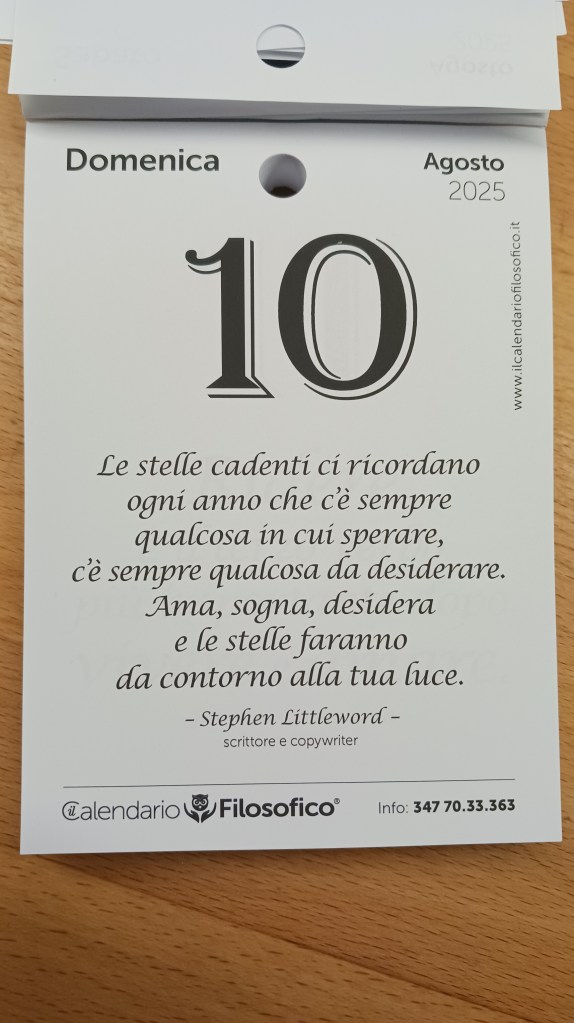
”Le stelle cadenti ci ricordano ogni anno che c’è seumpre qualcosa in cui sperare, c’è sempre qualcosa da desiderare. Ama, sogna, desidera e ele stelle faranno da contorno alla tua luce.”
”Shooting stars remind us every year that there’s always something to hope for, there’s always something to desire. Love, dream, desire, and the stars will frame your light.”
Pretty poetic. Or is it?
Here’s something useful for those who study the art of influencing people through language, e.g. for public speakers.
Note that the key term in this quote is different in different languages and gives a different message to the reader.
Usually something going upwards is understood as positive, and something going downwards is considered negative.
In Italian, ”stelle cadenti”, ”falling stars”, go down. That’s usually understood as something negative and not seen very often in quotes that are supposed to inspire.
So, why are the ”stelle cadenti” still inspiring for us? It’s because of another popular dichotomy used in metaphors: light versus darkness. Light is good, and shooting stars shine a bright light.
Herein lies the reason why the inventor of the above quote didn’t use the term meteor instead of a shooting star. After all, both words are about the same thing.
Our minds visualize a meteor more easily as something going down. In addition, the remains of a meteor are called by a similar term, meteorite, and a meteorite is made of dark stone. No shining light.
So, two bad things in a meteor. We are brought up learning that light is better than dark, and upwards is better than downwards.
Therefore, a ”shooting star” inspires, a ”meteor” does not.
The choice of words is of crucial importance for a writer, as well as for a public speaker.


 Would you like to become a better communicator?