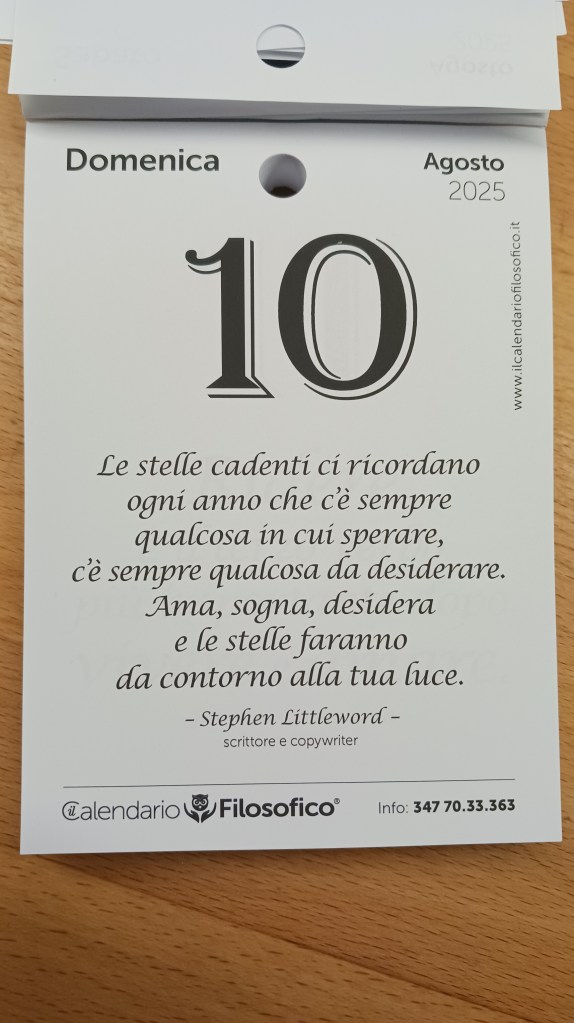
”Le stelle cadenti ci ricordano ogni anno che c’è seumpre qualcosa in cui sperare, c’è sempre qualcosa da desiderare. Ama, sogna, desidera e ele stelle faranno da contorno alla tua luce.”
”Shooting stars remind us every year that there’s always something to hope for, there’s always something to desire. Love, dream, desire, and the stars will frame your light.”
Pretty poetic. Or is it?
Here’s something useful for those who study the art of influencing people through language, e.g. for public speakers.
Note that the key term in this quote is different in different languages and gives a different message to the reader.
Usually something going upwards is understood as positive, and something going downwards is considered negative.
In Italian, ”stelle cadenti”, ”falling stars”, go down. That’s usually understood as something negative and not seen very often in quotes that are supposed to inspire.
So, why are the ”stelle cadenti” still inspiring for us? It’s because of another popular dichotomy used in metaphors: light versus darkness. Light is good, and shooting stars shine a bright light.
Herein lies the reason why the inventor of the above quote didn’t use the term meteor instead of a shooting star. After all, both words are about the same thing.
Our minds visualize a meteor more easily as something going down. In addition, the remains of a meteor are called by a similar term, meteorite, and a meteorite is made of dark stone. No shining light.
So, two bad things in a meteor. We are brought up learning that light is better than dark, and upwards is better than downwards.
Therefore, a ”shooting star” inspires, a ”meteor” does not.
The choice of words is of crucial importance for a writer, as well as for a public speaker.
My daily Duolingo.
 Would you like to become a better communicator?