Tag Archives: Communication

Why does the term ”shooting star” inspire more than a ”meteor”?

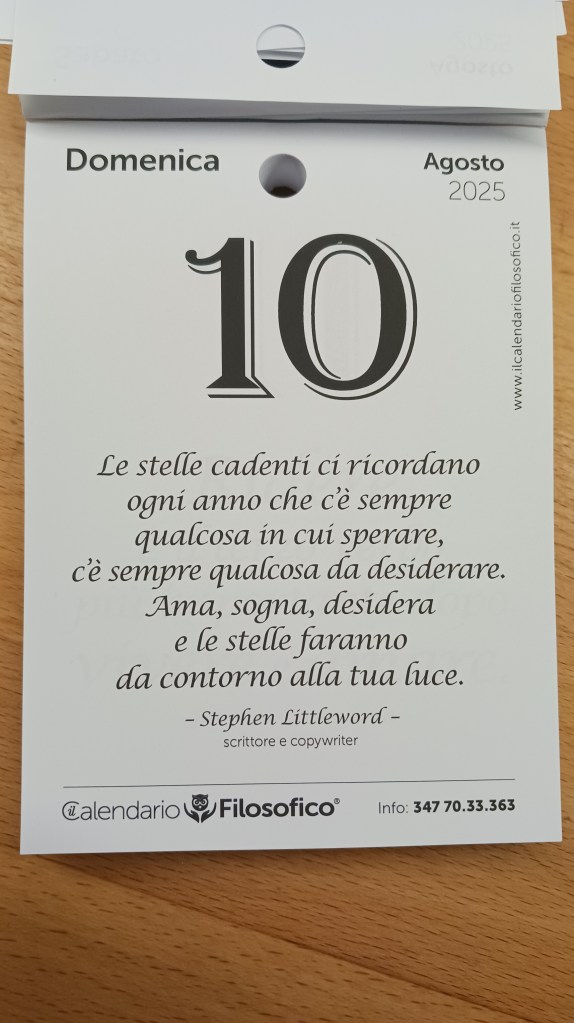
”Le stelle cadenti ci ricordano ogni anno che c’è seumpre qualcosa in cui sperare, c’è sempre qualcosa da desiderare. Ama, sogna, desidera e ele stelle faranno da contorno alla tua luce.”

”Shooting stars remind us every year that there’s always something to hope for, there’s always something to desire. Love, dream, desire, and the stars will frame your light.”

Pretty poetic. Or is it?

Here’s something useful for those who study the art of influencing people through language, e.g. for public speakers.

Note that the key term in this quote is different in different languages and gives a different message to the reader.

Usually something going upwards is understood as positive, and something going downwards is considered negative. 

In Italian, ”stelle cadenti”, ”falling stars”, go down. That’s usually understood as something negative and not seen very often in quotes that are supposed to inspire. 

So, why are the ”stelle cadenti” still inspiring for us? It’s because of another popular dichotomy used in metaphors: light versus darkness. Light is good, and shooting stars shine a bright light.

Herein lies the reason why the inventor of the above quote didn’t use the term meteor instead of a shooting star. After all, both words are about the same thing.

Our minds visualize a meteor more easily as something going down. In addition, the remains of a meteor are called by a similar term, meteorite, and a meteorite is made of dark stone. No shining light.

So, two bad things in a meteor. We are brought up learning that light is better than dark, and upwards is better than downwards. 

Therefore, a ”shooting star” inspires, a ”meteor” does not.

The choice of words is of crucial importance for a writer, as well as for a public speaker.

My daily Duolingo. 

The power of teamwork – Creating the building blocks for effective conflict resolution

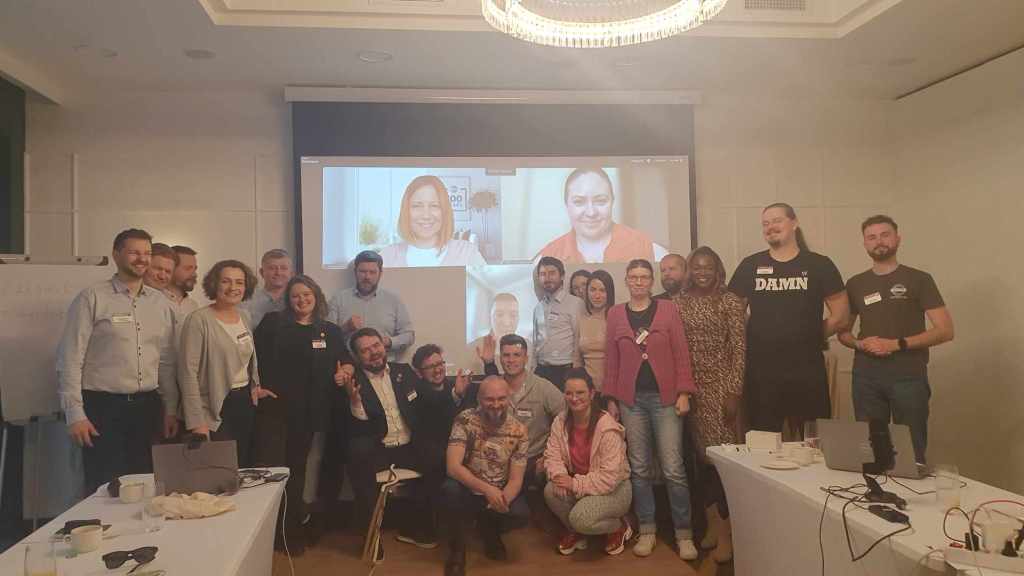
Getting big things done takes a village. At Toastmasters International, my public speaking organization, the year ends at the end of June. So, I thought it’s time to say thank you to a couple of good folks.

Today I have served two years as the Conflict Resolution Adviser and had the privilege to lead the Conflict Resolution Team for our Toastmasters International, District 108, comprising seven countries: Poland, Estonia, Latvia, Lithuania, Finland, Russia and Kazakhstan.

It’s been quit an incredible journey and it wouldn’t have happened without the following people.

Olga Turek-Woźniak was the first Conflict Resolution Manager at our District a few years back. She got things started, encouraged me to take this role and gave me good advice in the beginning.

Kamil Chmiel, as the District Director, asked me two years ago to accept the role of the Conflict Resolution Adviser in our organization. First I hesitated but I’m glad I said yes.

Łukasz Chomicz, as the District Director for the past one year, asked me to serve another year.

Kamil and Łukasz have been great partners in making things happen.

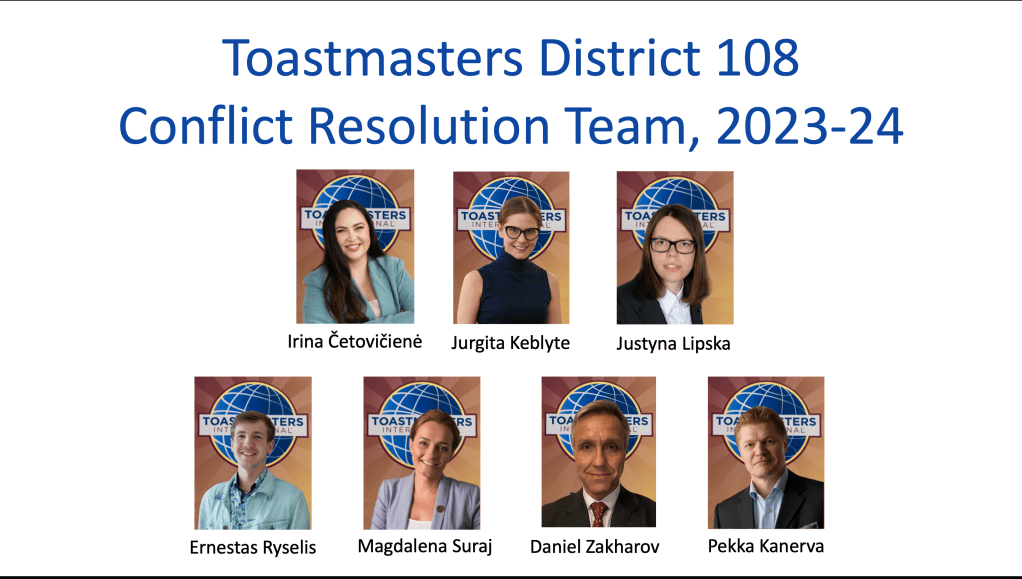
The fantastic fantastic Irina Četovičienė, Jurgita Keblyte, Justyna Lipska, Ernestas Ryselis, Magdalena Suraj and Daniel Zakharov served on my team in the 2023-2024 term.

The equally fantastic Roberto Bolomey, Irina Četovičienė, Paweł Lachowicz, Michał Moroz, Ignas Prakapas, Vadim Vasilyev and Karolina Wróbel served on my team for the 2024-2025 term.

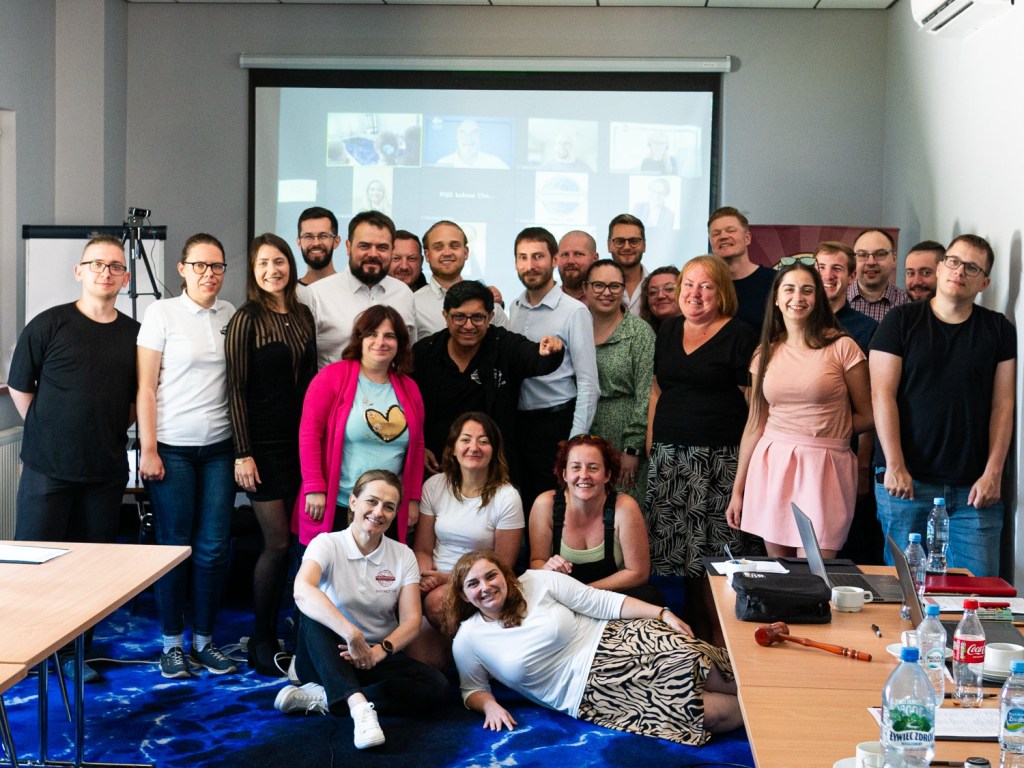
With these teams, we have coached our Toastmasters members through tough spots, helped them manage and resolve conflicts, organized trainings and workshops and created a Conflict Resolution Guidebook for all our members to use.

Within these teams we have also supported, coached and educated one another.

One of my most memorable moments of these two years was when my team members said how much they had benefited themselves from learning more about conflict resolution.

We have not only helped other people but as a by-product, we have grown as human beings ourselves.

In addition to the team itself, my Polish brother, former Region 10 Advisor Piotr Chimko was always there, ready to converse about things big and small.

Working with Margherita Brodbeck Roth was one of my most rewarding and educational experiences in the past two years. Thank you.

Last but not least, there’s the Core Team of District 108, including our Area Directors: it’s been a tremendous honor and pleasure to work with each one of you. Oftentimes it’s also been a lot of fun. It would be too many names and too many fond memories to list here. You know who you are.

If I forget to mention someone, it’s because of my occasionally bad memory.

As to my biggest achievement in these two years, I think it is that I had the wisdom and luck to be able to recruit such talented and motivated members to my team. Together we have created a strong foundation for the future.

The future looks very good also because Michał Moroz will lead our conflict resolution function for the next year.

A new Toastmasters year begins tomorrow, so what next? Time will tell. For now, I’ll just cherish all the learning and all the friendships.

A heartfelt thank you to everyone who’s been part of this journey. As Ignas Prakapas said at our last team meeting, this is not a goodbye but a see you later!

How comfortable are you dealing with disagreements? – Find out my seven lessons learned

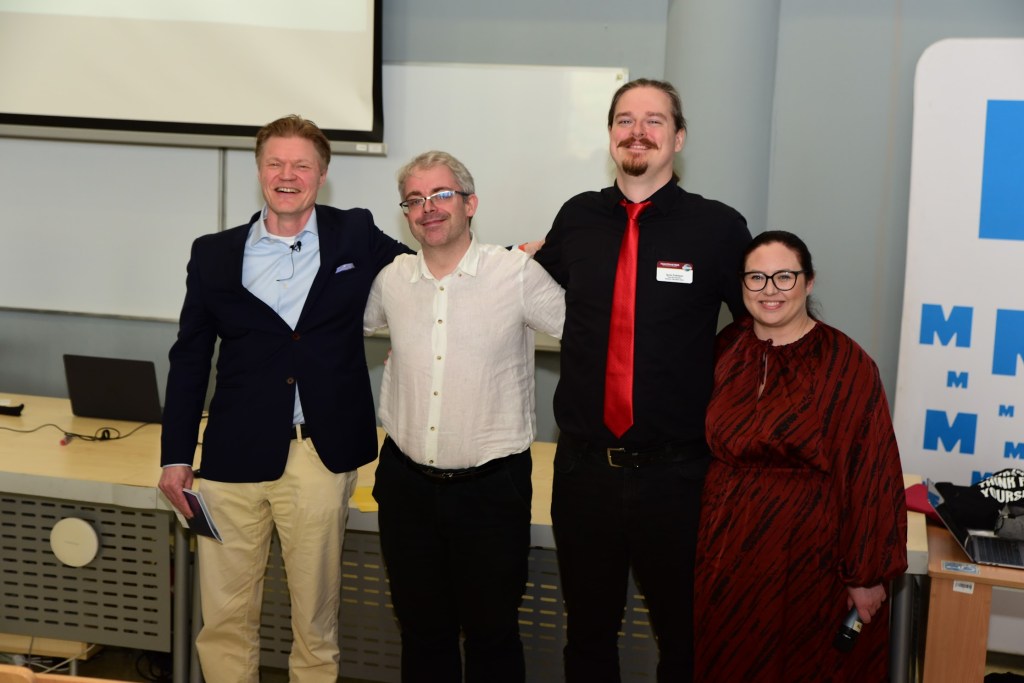
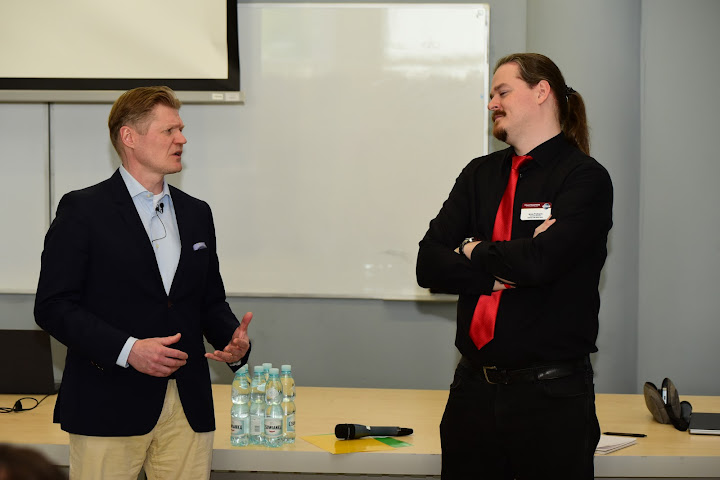
Ignas and Pekka performing a role play on corrective feedback. Photo credit: Wiktor Guryn.

Did you know that dealing with disagreements, conducting difficult conversations and resolving conflicts are skills that can be learned?

They are skills that can be learned just like public speaking, sales or leadership skills.

Your ability to respond to disagreements and conflicts as well as to conduct difficult conversations affects your happiness and success at work and in your private life, every day. 

I have today served two years as the Conflict Resolution Adviser for a global public speaking organization that I’m a member of. 

The organization is called Toastmasters International, and I’ve had the privilege to lead the Conflict Resolution Team at the organization’s fantastic District 108 comprising seven countries: Poland, Estonia, Latvia, Lithuania, Finland, Russia and Kazakhstan. 

It’s been a pretty incredible journey and and these are some of the lessons I have learned:

  1. A conversation, a disagreement or a conflict is primarily about emotions. Facts also count, but much less.
  2. People have a deep need to feel heard, to feel acknowledged, to feel seen. They need to have their emotions acknowledged. Until that has happened, they are not prepared to listen to your point of view. That’s the key to conducting difficult conversations and resolving conflicts.
  3. We usually don’t like to take the initiative to address conflicts because we are afraid that speaking out may put us in trouble. We are afraid of damaging a relationship, our status in our community, or our position at the workplace.
  4. Yet, when we don’t speak out about our frustration, we tend to act it out. The other party is usually aware that something is wrong even if we don’t take the initiative to resolve the conflict.
  5. The longer a conflict is allowed to simmer, the more difficult it becomes to solve. I have seen many conflicts that have been going on for years before someone speaks out.
  6. Most conflicts start small and are about relatively small things. Often they are about nothing more than well-meaning people misunderstanding each other. Then they easily grow when people start expecting the worst from each other.
  7. I’ve seen people take disagreements to court, even conflicts about seemingly small things, because feelings have been hurt. The sad thing is that a court of law is not a place to get your emotions acknowledged. From a court you don’t get justice, you get a verdict. 

The good news, again, is that conflict resolution skills can be learned by anyone. It takes time and dedication, but it’s well worth it, and I believe it’s an investment that we all should make. 

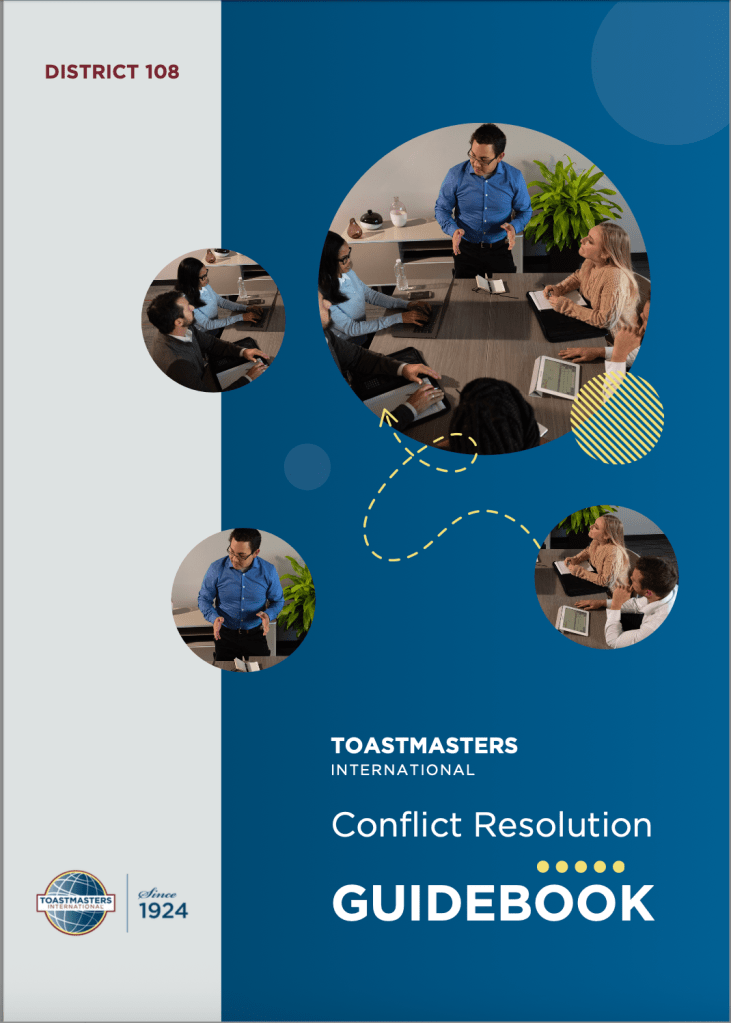
If you’re interested in learning about how to deal with disagreements, a good place to start is to download the Conflict Resolution Guidebook that my team has recently published. You can download it on this web page: https://toastmastersd108.org/conflict-resolution-team/ or directly from here: https://drive.google.com/file/d/1ODkWxLLqCtK6pin176xocNHTGz2JwZiL/view.

The guidebook is free of charge for anyone and I don’t even ask you to give your email address or any other information about yourself in exchange. 

The only thing I ask from you is to read it, apply what you have learned and share it with anyone you think might benefit from it.

I believe this guidebook may be useful also for Toastmasters in other parts of the world, as well as basically any citizen of the planet.

This guidebook is brought to you by the Conflict Resolution Team of Toastmasters International, District 108: Roberto Bolomey, Irina Četovičienė, Paweł Lachowicz, Michał Moroz, Ignas Prakapas, Vadim Vasilyev, Karolina Wróbel and yours truly.

Pekka-Torun-workshop-guidebook.
Proudly presenting the brand-new Conflict Resolution Guidebook published by our team. Photo credit: Wiktor Guryn.

So, once again, go ahead and download the guidebook from the link on this page, and benefit!  https://toastmastersd108.org/conflict-resolution-team/.

Artificial intelligence and humans competed in public speaking – who won?

Trying hard to deliver a speech as it was generated on the spot by artificial intelligence.
Photo credit: Polina Feshchenko

This week artificial intelligence (AI) and humans competed against each other for the first time at a public speaking club in Helsinki.

The task was to give a short, improvised speech about a topic given to the speakers on the spot. The speakers, including ChatGPT, had just thirty seconds to prepare on stage before delivering the speech.

ChatGPT’s speech topic was “Explain to a five-year-old what the internet is”.

This was the prompt given to the computer:

Write a humorous two-minute speech to a five-year old about the internet, with the past, present, future structure, containing five metaphors, two quotes and including the word contentious three times, and mentioning Tuomas, Topi and Lauri and the Stadi Talkers Toastmasters Club.

Here’s the speech generated by the computer, and delivered by the undersigned:

Good morning everyone!

My name is Tuomas and I’m here to talk to you about the internet.

Let’s start with the past. Back in the day, the internet was like a dark and mysterious forest. It was full of secrets and surprises, but it was also a bit scary. You had to be careful not to get lost in the depths of the internet.

Now, let’s move on to the present. The internet is like a big playground. It’s full of exciting games, funny videos, and interesting people. It’s a great place to explore and learn new things.

Finally, let’s look to the future. The internet is like a giant library. It’s full of knowledge and information about almost anything you can think of. It’s also a great place to connect with people from all over the world.

Now, let’s talk about the people who use the internet. They are like a family. They share their experiences, their ideas, and their stories. They also help each other out when they need it.

The internet can also be a contentious place. People often disagree and argue about different topics. That’s why it’s important to be respectful and open-minded when discussing things online.

As Topi, one of the members of the Stadi Talkers Toastmasters Club, said: “The internet is a great tool for learning, but it’s also full of dangers. We must be careful to use it responsibly.”

And as Lauri, another member of the Stadi Talkers Toastmasters Club, said: “The internet is a great place to explore and discover new things, but it can also be contentious. We must be careful to stay safe online.” So, my five-year-old friend, remember to use the internet responsibly and stay safe!

Thank you for listening.

Let’s look at how the computer did.

What the AI did well and where it failed

  • The speech is complete and makes sense in many ways.
  • ChatGPT used the instructed speech format (past, present, future), even though halfway through the speech it completely abandoned it.
  • The speech contains a variety of metaphors, probably more than we’d see in an average two-minute speech.
  • There’s plenty of material in the speech that can be used when designing a real speech.
  • The speech was supposed to be humorous, but humor was missing.
  • The speech began with a “Good morning”, at 7pm in the evening.
  • ChatGPT made a wrong guess about the name of the speaker.
  • “Back in the day”, the internet was NOT like a dark and mysterious forest. It was actually a pretty joyful place.
  • ChatGPT had no meaningful vision about the future of the internet.
  • ChatGPT is usually good at finding quotes and addressing them to the correct person. In this speech, however, it put words in the mouths of the wrong people.
  • Last but not least, AI almost completely missed its target audience. ChatGPT did hardly anything to adjust its message to a five-year-old as instructed.

Who won the speech contest?

The contest was won by one of the humans. His speech was well structured, humorous, and to the point.

Out of the 23 voters at the club, only two gave their votes for ChatGPT.

In my next post, I’ll write about the implications of what happened in the contest. Stay tuned.

P.S. From now on, I’ll include a discussion about using AI in speech writing in all of my public speaking trainings.

An analysis of Trump’s inaugural address – a successful speech or not?

Can playing high status go over the top? Trump’s eagerly awaited speech had a number of technically good elements, but as a whole it was no stellar performance.
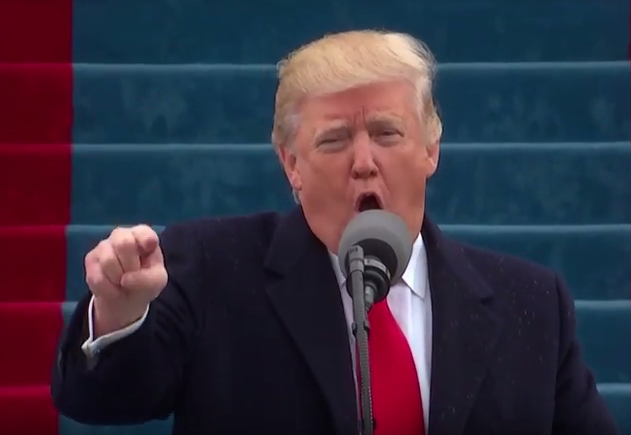
trump-inaugural-speech-january-20-2017-president-inauguration

During the last few years at Toastmasters, a global organization devoted to developing public speaking and leadership skills, I have evaluated dozens if not hundreds of speeches and given structured feedback to speakers. Hence, analyzing Trump’s inaugural address felt like the most natural thing to do.

The intriguing question was: Trump is an excellent speaker but also an exceptionally contradictory person – how would he do in his first speech as president?

While the speech had a number of technically good elements, as a whole it was a disappointment. Here’s why.

The goal of the speech

In the first place, the success or failure of a speech is related to its goal.

According to Trump’s advisers, the goal of the speech was to reach out and unite the country.

Everyone who Trump attacked during his campaign – that is, most Americans – listened to his speech very carefully. This was a unique opportunity for him to mend burned bridges.

Still he didn’t utter a single positive word about Hillary Clinton or her supporters, about women, latinos, muslims, immigrants, sexual minorities, the disabled, Democrats, Republicans, the media, the US intelligence community or the foreign allies of the US. Nor did he provide any positive message for those concerned about climate change or national security. The same applies to those angered by his habit of constant lying.

All these people were disappointed in Friday’s speech. Down the line, they’ll be ever harder to convince by anything Trump says.

Talking to a hostile audience is one of the most difficult situations a speaker might face.

Although most of the live audience were Trump supporters, the main audience of the speech consisted of all 320 million Americans, and secondarily, the rest of the world. Trump is supported by a minority of Americans and by an even smaller minority of non-Americans. In fact, slightly short of 20 percent (63 million people) of all Americans walked into a voting booth and voted for Trump.

A speaker facing a hostile audience often doesn’t even try to win it over because it’s a tough job. However, the newly elected leader of a nation needs to try to unite his country and to get at least some sympathy from his adversaries. It would help him tremendously in his work.

Yet it seems like the real goal of Trump’s speech was not reaching out and uniting the nation, but rather pleasing his established supporters and perhaps trying to rationalize his upcoming policies as president.

In humoring his supporters, Trump’s speech was probably successful. He repeated his tried and tested, simple campaign messages. The speech also fit well with his stated strategy of bypassing the political parties and the media and talking directly to his supporters instead.

In trying to rationalize his upcoming policies, the speech was a failure, however. The message didn’t hit home with a critical listener. It was simply too illogical and too far removed from reality. One needs to be pretty deep in Trump’s world in order to imagine having heard anything even close to watertight argumentation.

For hard-core Trump supporters, the argumentation may have worked. So, it’s really all about what the goal of the speech was. Unfortunately, that we don’t know.

Using high status

High and low status are terms used in the world of theater. High status refers to a person adopting a dominant position relative to those around him. High status can communicate for example self-confidence or arrogance. Trump’s performance on Friday – as his performances during the campaign trail – was pure high status.

Some expressions of high status we saw in the speech were a low tone of voice, slow and clearly articulated speech, a head barely moving, a severe and relatively expressionless face, mouth and lips pointing outwards as well as half-closed eyes and frowning.

In addition, we saw a relatively motionless body with only the arms making controlled gestures. Trump kept his hands far from his head. The palms of his hands would often be open, fingers apart from each other, with one finger occasionally pointing at the audience.

These status techniques are straight from the book and they are studied at theater schools.

Public speakers tend to use high status most of the time and this is normally recommended. However, when exaggerated, the audience’s experience may tilt towards the negative connotations of high status, rather than the positive ones.

All of this, accentuated by the frequently aggressive tone of voice and message, gives an impression of the speaker overly emphasizing himself and placing himself above other people. The style appears authoritarian, especially when the speech includes passages such as ”There should be no fear. We are protected, and we will always be protected.”

Here the speech starts to sound like the talk of an omnipotent father figure, who expects the audience to see themselves as his subjects. Oddly enough, the ”I will protect you” message is contradictory to the all-American ideals of individualism, individual initiative and freedom as well as the cherished right for individuals to bear arms.

The manner Trump dressed for his address matched his speaking style: a black suit and overcoat together with a red tie communicate power.

Structure and content of the speech

Structure

Trump told the audience that the country is in a terrible state, called out the culprits and told that the future is bright.

The structure of the speech was clear. Trump used simple words, lots of powerful slogans and almost every word he pronounced was easy to hear. The good old rule of three, i.e. reciting lists of three things, was also frequently used.

Trump made effective use of pauses and some parts of the speech included powerful verbal imagery. The speech ended with a strong “Let’s make America great again” sequence, which probably worked well with his supporters.

On the other hand, Trump’s use of voice and his body language, while not monotonous, were quite repetitive, like a train going at a steady speed. This occasionally reduced the effectiveness of the words he spoke.

For example: reading the transcript of Trump’s speech, there are actually plenty of mentions that seem to aim at uniting the nation. Trump talked about ”healing our divisions”, about solidarity, ”we must debate our disagreements honestly”, ”there is no room for prejudice”, and ”whether we are black or brown or white”.

Still, when watching the speech on video, those words somehow don’t stand out as unifiers of the divided nation. It didn’t sound like the words were emphasized in the sense of rebuilding burnt bridges.

Part of this impression is also because the presumably unifying words were mostly presented in a somewhat odd context of ”[opening one’s] heart to patriotism”, ”total allegiance”, loyalty and ”a new national pride [that] will … heal our divisions”.

Many listeners would ask whether gay Americans are invited to that new pride? How about the latinos, muslims etc.?

Content

This brings us to the content of the speech, which caused the speech to fail except for Trump’s existing supporters.

Trump’s description of the horrendous state of the country was largely false and understood as such by most listeners. The US economy, industry, employment, crime rates and the military are not in such a catastrophic shape as he claimed. Those statements alone would be enough to strip most public speakers from much of their credibility.

Trump also told who are to blame, i.e. who the enemies are: politicians and foreign countries. This includes foreign businesses and people, whether they are immigrants, employees of foreign companies abroad or terrorists.

This means Trump wanted the audience to believe that even as president, he himself is not a politician. That’s not credible.

It’s also interesting to note who was missing from the list of enemies: the rich.

An old quote comes to mind here: ”What you are speaks so loudly that I cannot hear what you say”.

The isolationist tone of the speech was detached from reality. No country can isolate itself from the world, not even North Korea. In addition, many of the toughest issues facing individual nations can only be attacked through international cooperation.

The speech made no mention of climate change, even though it’s a far bigger issue for the US than radical Islamic terrorism – the only issue Trump mentioned as meriting the kind of international cooperation that he otherwise spoke so strongly against. Since 2001, the US hasn’t seen any significant radical Islamic terrorism and there have been no signs of it increasing within the the country’s borders.

For other countries, Trump’s message was menacing.

The ”America First” slogan is strange, as it’s always been clear that the US primarily seeks its own interest – just like any country. Again, the message seemed to be targeted only at Trump supporters, not to the nation.

The lack of logic in the speech continues.

“January 20, 2017, will be remembered as the day the people became the rulers of this nation again.” While Trump’s speech correctly used plenty of ”we” and ”you” instead of ”I”, one easily gets the impression that people might equal just one person. And if you look at the administration composed of millionaires, billionaires and family members, the notion of them representing the common man or woman becomes quite surreal in the listener’s mind.

Trump’s message of ”people” and ”a movement” can be understood from the fact that many of his supporters still feel that he honestly represents their interests.

So again, the message was apparently directed not at the nation but at Trump’s supporters.

Therefore, the big questions about this speech are: why did Trump not talk to his opposition? Was it only because he, as many public speakers, knows that it’s hard to convert those that disagree with you?

End note: a speech evaluator’s difficult task

It was no easy task to evaluate Trump’s inaugural speech, because I, like everybody else, already had an opinion about him. Yet, one should try to evaluate a speech from an objective viewpoint.

I have learned, both as a public speaker and as a speech evaluator, that each piece of feedback is only the point of view of a single person and therefore shouldn’t be taken too seriously. I have seen how even experienced evaluators give very different feedback on the same speech.

However, when honest and constructive feedback repeatedly generates similar comments to a speaker, then he or she can be quite confident that the feedback might be valid, whether it’s about one’s strengths as a speaker or about something one could try to improve.