There are conflicts between people in all organizations. Toastmasters, an organization dedicated to helping people excel at public speaking, is a rare exception in having had the wisdom to of set up a conflict resolution function within its organization.
What do I mean by a conflict?
Conflicts are usually the quite mundane issues and arguments between people at a business, at a hobby or at home.
Most often it’s about someone having insulted another person, either on purpose or unknowingly.
Then, over the weeks, months and surprisingly often even years, the issue grows. People avoid talking to each other and instead talk negatively about others behind their back.
A huge amount of people’s energy is wasted in a negative spiral, instead of productive work.
Stress levels rise.
All this prevents organizations from achieving their full potential. It makes it harder for people and organizations to reach both their short- and long-term goals, whether they are about sales, profit or qualitative goals.
For the past twelve months, I’ve had the privilege of running a conflict resolution team at Toastmasters. While the organization is global, my district consists of seven countries and about 2,000 members from the Baltics, Finland, Kazakhstan, Poland and Russia.
For the past year, the team led by me has been able to help people resolve a number of issues between people. As a result, this district has been more effective and better reached its goals, as well as supported the well-being of the members.
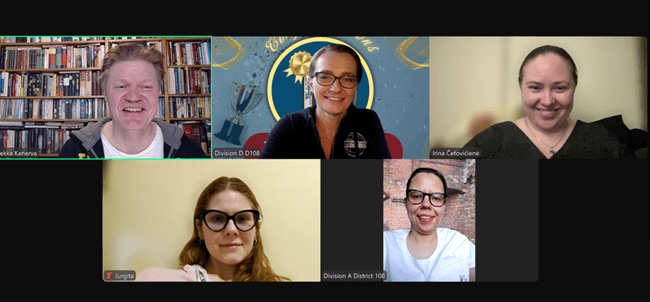
Recently, something extraordinary happened at the final meeting of the outgoing conflict resolution team.
I asked everyone to tell what has been good about our activities, as well as what could be done better next year. To my surprise, everyone mentioned something I didn’t expect.
Everyone said that in addition to having been able to help other people, they had grown personally.
Helping other people resolve their conflicts had made all group members more aware of their own behavior in conflict situations. As a result, they had begun to think about new ways to navigate through difficult conversations of their own.
I realized that I had had exactly the same experience. For example, I now react more calmly in a difficult situation than before.
I’m also more aware of the different ways of behavior I can choose from when a potential conflict arises.
Increasingly, I become conscious of the various options on the spot, instead of as an afterthought: “I wish I had said this and that” or “I wish I had not said this and that”.
It turns out that helping other people resolve difficult situations was a twelve-month free of charge self-development course.
So, huge thanks to Magdalena Suraj, Irina Cetoviciene, Daniel Zakharov, Jurgita Keblyte, Justyna Lipska and Ernestas Ryselis for serving in the team.
Special thanks Kamil Chmiel for coming up with the idea in the first place, and to Piotr Chimko and Olga Turek-Wozniak for encouraging me to take on the challenge.
Does your organization have a conflict resolution adviser?
 Would you like to become a better communicator?